# Getting Started

The first time Study Tracker starts-up, it will perform some basic configuration and record-creation, based on how your install was configured. One of these key steps is the creation of the 'Study Tracker Admin' user, which will allow you to sign into your tenant and configure your environment. The username and password for this account can be defined in the `application.properties` file. If no password was provided, a temporary one will be assigned and printed in the application log at startup:

<figure><img src="/files/s1sSJJzOuZZDfggdM4w1" alt=""><figcaption><p>Application startup log, including the output specifying the admin username and password.</p></figcaption></figure>

{% hint style="info" %}
You should change this password as soon as possible!
{% endhint %}

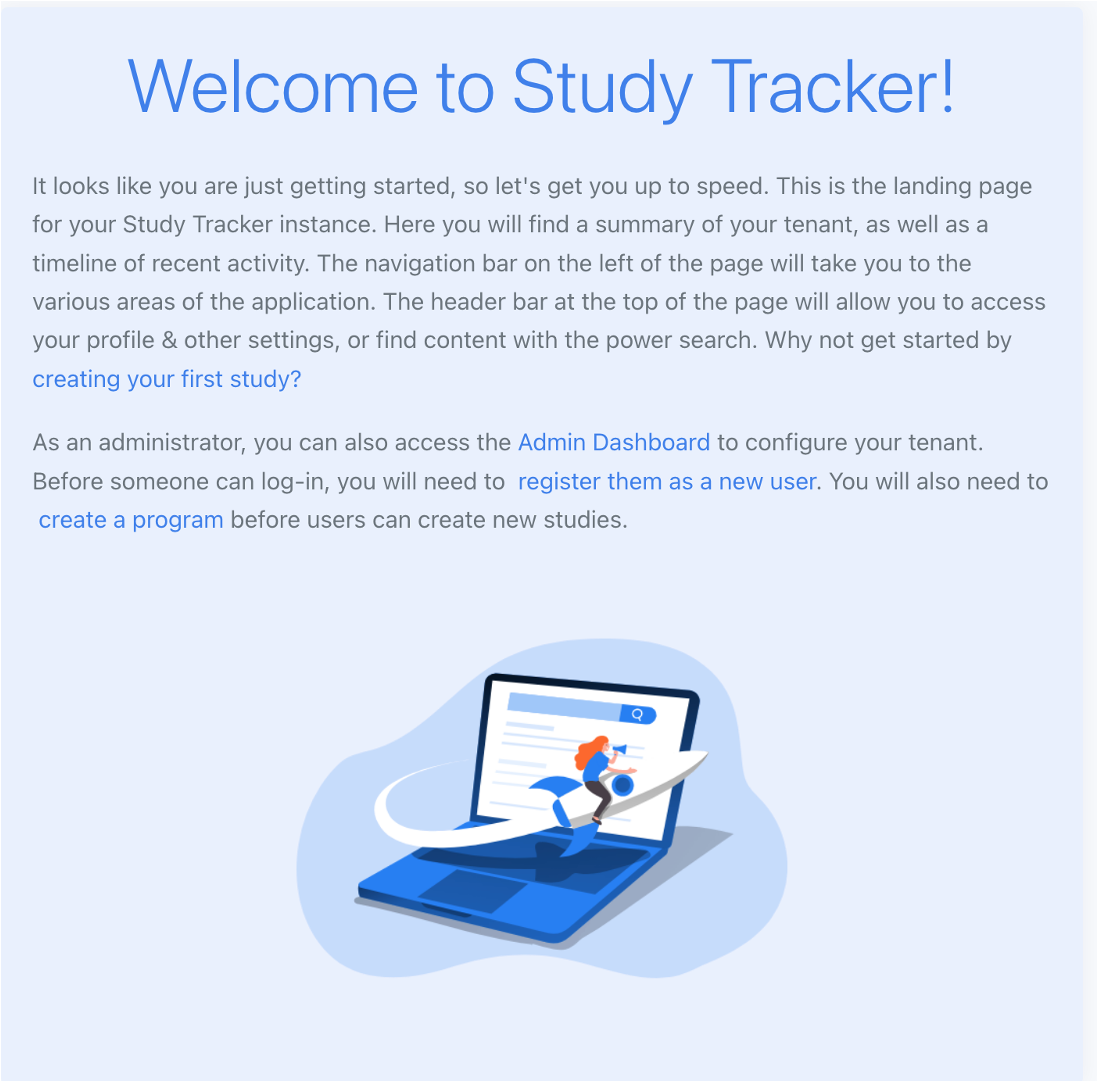
The first time you sign into Study Tracker, you will be greeted with the following message, informing you there are a few setup steps before scientists can begin capturing their work:

<figure><img src="/files/4xGOxcbxnblEyuvD1j3H" alt="" width="563"><figcaption><p>The Study Tracker welcome page.</p></figcaption></figure>

Here are the recommended actions you should take before letting users in to the new system:

* Register new users
* Connect your electronic laboratory notebook (eg. Benchling)
* Connect cloud storage services (eg. Egnyte, OneDrive, or S3)
* Connect source code management systems (eg. GitLab)
* Create Programs for users to organize their work into

Most of these tasks can be performed in the Admin Dashboard, which can be reached by clicking on your account name in the top-right corner of the screen or by navigating to `/admin`.

<figure><img src="/files/BBydFpfdEsXOutOiJmsQ" alt=""><figcaption><p>Link to the admin dashboard in the user drop-down.</p></figcaption></figure>


---

# Agent Instructions: Querying This Documentation

If you need additional information that is not directly available in this page, you can query the documentation dynamically by asking a question.

Perform an HTTP GET request on the current page URL with the `ask` query parameter:

```
GET https://study-tracker.gitbook.io/documentation/managing-your-tenant/getting-started.md?ask=<question>
```

The question should be specific, self-contained, and written in natural language.
The response will contain a direct answer to the question and relevant excerpts and sources from the documentation.

Use this mechanism when the answer is not explicitly present in the current page, you need clarification or additional context, or you want to retrieve related documentation sections.